There is no single answer, because a background check in India closes when its slowest check does. Checks that read a digital record, such as identity, court records and EPFO and TDS records the candidate has linked, can close quickly. Checks that wait for a person to reply set the pace: a university's verification desk, a past employer's HR team, a field visit or the police. The universities cited below quote between 2 working days for an urgent request and 30 days, often counted from the day they have complete documents and the fee.
Why there is no single number
A typical package runs several checks at once, and each one waits on a different organisation. The report closes when the last answer arrives. Two cases with the same checks can finish days or weeks apart because one university replies by email and another by post, or because one past employer answers the first request and another needs three reminders.
The clock also starts later than most hiring managers expect. Many issuers count from the day they receive a complete request and the fee, not from the day you sent it. A missing registration number or an unpaid fee can stop a check before it starts.
Who sets the pace, check by check
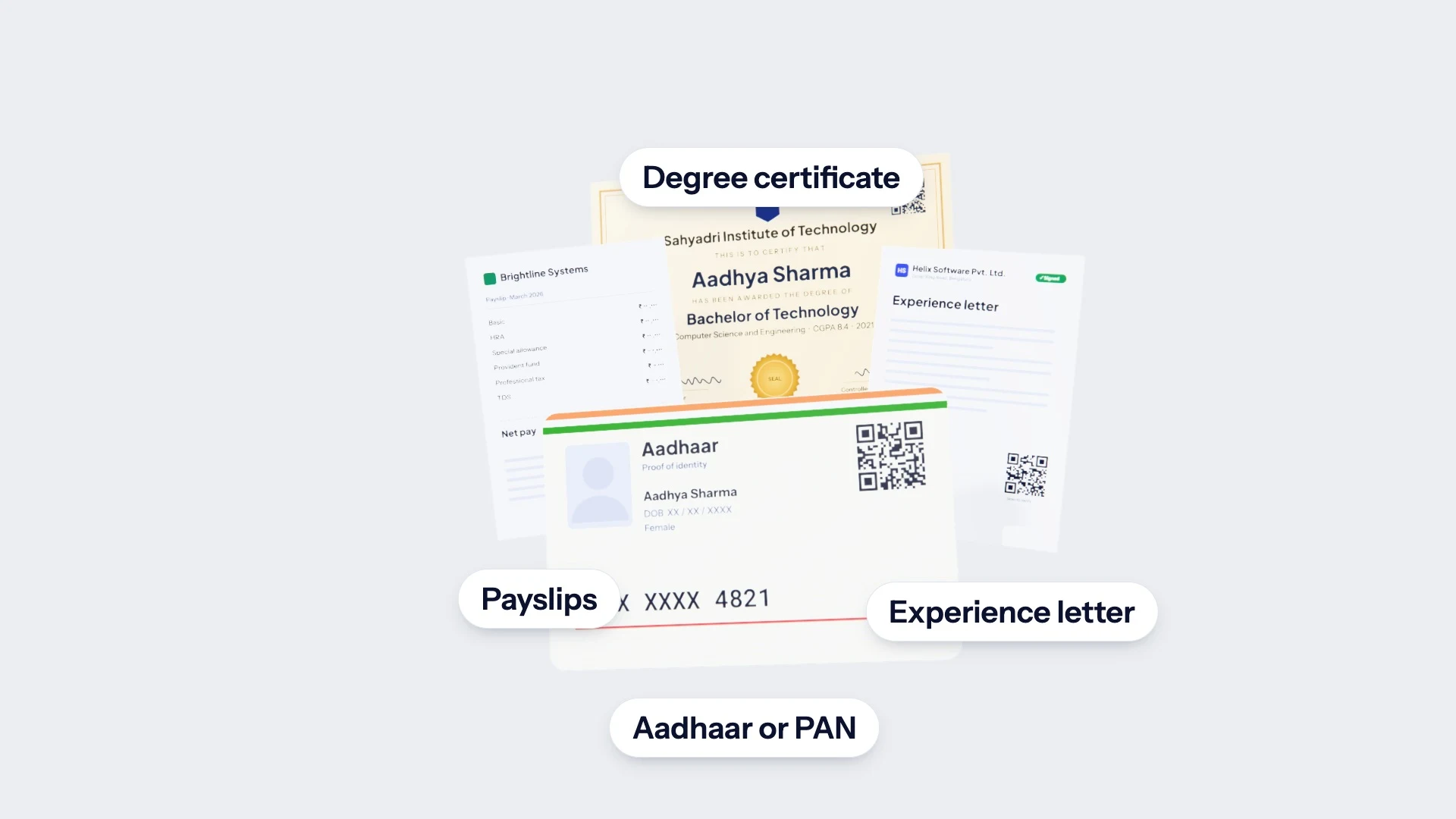
| Check | Who has to answer | What sets the pace |
|---|---|---|
| Identity | The candidate, through an OTP check | Whether the candidate completes it, and whether names match across records |
| Education | The university or college | Its route (portal, email or post), its fee and the paperwork it asks for |
| Employment records | EPFO and TDS records the candidate links | Whether the candidate links them, and gaps in the records |
| Past-employer confirmation | The past employer's HR team | How fast HR replies, and whether the right contact is known |
| Address | The candidate, digitally or at a visit | Whether the address is complete and someone is at home |
| Court records | Court case records, searched digitally | How many namesake matches need review |
| Police verification | The state police | The state police's own process |
| References | The referees | When referees pick up or reply |
| Professional licence | The council that granted it | Whether the council has an online register |
| Credit report | The candidate | When the candidate downloads and shares it |
Database and watchlist, drug and medical, and digital footprint checks run through specialist partners, on their own timelines.
Education: published timelines vary widely
In October 2026 we reviewed the published verification process of the 1,460 universities and Institutes of National Importance on the UGC and Ministry of Education lists. About one in ten publishes a turnaround, and most of those quote between four and fifteen working days. The terms behind those numbers differ a lot:
- NMIMS says regular verification requests take 7 working days and urgent ones 2 working days. Processing begins after the fee payment is confirmed, and requests with incomplete documents are declined (NMIMS).
- SVNIT Surat says verification is done within 15 working days "if submitted documents are proper in every respect" (SVNIT).
- Shivaji University, Kolhapur asks for the request on the institution's letterhead and sends the result by post after 5 working days, so postal time comes on top (Shivaji University, May 2026).
- Savitribai Phule Pune University lists a resolution time of 30 days for certificate verification on its online portal (SPPU).
Where a university publishes nothing, plan for a letter or email that waits in a queue, and start the check at the offer stage.
Employment: records move fast, replies do not
EPFO's Service History feature shows a member's previous and current employers, with dates of joining and exit, against their UAN (Business Today, August 2026). Tax deducted from salary shows in the candidate's Annual Information Statement. Once the candidate links these records, matching them is quick. They do not state designation or the reason for leaving, and the same Business Today guide tells members to check for missing employment periods, so a record can have gaps that need a follow-up question.
The past employer's confirmation is the step nobody can schedule. It slows down when the request lands in a shared HR inbox, when the HR contact has moved on, when the company has merged or closed, or when the request lacks the employee code HR needs to find the file.
Address
A digital address check moves as fast as the candidate responds. A physical visit depends on finding the house and finding someone in it. Incomplete addresses, hostels and paying-guest rooms, and candidates moving between cities all lead to repeat visits. A landmark helps, and so does a DIGIPIN, the location code from India Post's open-source national addressing grid.
Court records
Court record searches are digital. The national eCourts service lets anyone search cases by party name, case number or CNR. The slow part is review: a common name returns other people's cases, and each match has to be checked against father's name, address or date of birth before anyone acts on it.
Police verification
Police verification follows the state police's own process, and the timing sits with them. It can be run online where the state police offer it, or offline. Tell candidates and hiring managers that this check runs on its own track, and decide in advance whether a joining date depends on it.
References, licences and credit reports
References move when referees answer, so ask candidates to tell their referees to expect a call. Professional licence checks are quicker where the council publishes an online register, such as the National Medical Commission's Indian Medical Register, and slower where you have to write to the council. A credit report is in the candidate's hands: RBI rules require credit information companies to give individuals one free full credit report a calendar year (RBI, September 2016), so the candidate can download it and share it when asked.
What slows checks down
- Starting late. Checks that begin after joining finish after joining. A discrepancy found weeks into the job is harder to act on.
- Incomplete requests. Many universities count from a complete application and a confirmed fee. Missing marksheets, an unsigned authorisation or a fee paid to the wrong account push the start date back.
- Paper routes. Letterhead requests, demand drafts and results sent by post add days that no one can speed up.
- Unknown HR contacts. A request sent to a general inbox, or to someone who has left, waits until it reaches the right person.
- Name mismatches. A changed surname, initials expanded differently or a spelling error across records sends a check back for clarification.
- Field work. Address visits and offline police verification depend on people being available.
What speeds them up
- Consent upfront. Send the notice and take consent for each check at the offer stage, in one request. The Digital Personal Data Protection Act, 2023 asks for a notice with every consent request (section 5) and for consent that is specific and limited to the stated purpose (section 6(1)). Doing it once, properly, avoids a second round of requests.
- Correct details. Collect the registration number and year of passing, the UAN, the employee code and an HR contact on the company's email domain, the full address with a landmark, and any earlier names. Check them before anything goes out.
- Issuers that answer digitally. A university or college that issues QR-verifiable certificates, a council with an online register and linked EPFO and TDS records all answer without a queue.
- Records already on a network. When the candidate already holds records that were verified at the source, the check reads them instead of asking the issuer again.
- Parallel checks. Run every check at once, and agree with the hiring manager which ones must clear before day one.
How this works on Checkkbox
On Checkkbox, the candidate approves each check from their phone. Records in their ADi Wallet are fetched from the source with their consent, and employment is matched across EPFO and TDS records, then confirmed by the past employer. Identity, education and EPFO/TDS employment checks close in under 15 minutes when the candidate's records are on the network. Past-employer confirmation takes as long as their HR takes to reply. That HR team confirms on a secure link and signs by typing their name, and a confirmation is not accepted unless the signer's email domain matches the employer's domain in the request. Court record checks are digital and usually come back within 15 minutes. Police verification is offered online where the state police offer it, or offline.
For degrees, universities and colleges that issue on Dygital.degree sign each certificate and issue it in the NAD standard format with a QR code, so a check reads the issuer's own record instead of waiting for a reply. They are signed by the Registrar, Controller of Examinations and Vice-Chancellor and anchored on Hyperledger, and any change to an issued certificate makes the QR check fail. Students fetch them into ADi Wallet and share them with a yes, so the education check that usually waits longest needs no letter at all. More than 20 universities and colleges issue on Dygital.degree, and more than 150 verification agencies verify academic records on Checkkbox (Company data, Oct 2026).
A short planning checklist
- Start checks when the offer is accepted, not after joining.
- Send candidates one list of what you need and why.
- Track turnaround by check type, so you can see which step is slow.
- Follow up on past-employer requests on a fixed schedule.
- Agree in writing which checks must clear before the joining date.
If you want to see how long checks take on your own candidates, book a demo and we will show your team the full flow.
Sources
- TheRollNumber, review of the published degree verification process, fee and turnaround of 1,460 universities and Institutes of National Importance on the UGC and Ministry of Education lists, October 2026. Institution lists from the University Grants Commission.
- SVKM's NMIMS, "Education Verification", accessed October 2026
- Sardar Vallabhbhai National Institute of Technology, Surat, "Education Degree Verification Procedure", accessed October 2026
- Shivaji University, Kolhapur, Students Facilitation Centre notice on verification of documents, May 2026
- Savitribai Phule Pune University, online certificate services, accessed October 2026
- Business Today, "Missing PF account? Here's how EPFO's service history can save taxpayers time and hassle", August 2026
- Income Tax Department, "AIS: Annual Information Statement", accessed October 2026
- India Post, "DIGIPIN", accessed October 2026
- eCourts Services, case status search, accessed October 2026
- National Medical Commission, "Indian Medical Register", accessed October 2026
- Reserve Bank of India, "Free Annual Credit Report to Individuals", RBI/2016-17/58, September 2016
- Ministry of Law and Justice (via MeitY), "The Digital Personal Data Protection Act, 2023 (No. 22 of 2023)", Gazette of India, August 2023