To spot a fake degree certificate, check two things: who awarded it, and whether that body could award that degree in that year. Seven warning signs cover most cases, from a name on UGC's fake universities list to an engineering degree earned by distance. No sign proves fraud by itself. A warning sign tells you to ask the university or college that issued the certificate, and its answer is what settles the question. Certificates issued on Dygital.degree give you that answer at once, through a QR check against the issuer's own record.
What warning signs can and cannot tell you
A degree certificate can fail in two ways. The paper can be false: forged, altered, or issued by a body with no power to award degrees. Or the paper can be genuine and belong to someone else. The signs below help with the first kind. They cannot catch the second, because a borrowed certificate is real and nothing on it looks wrong. Keep that limit in mind as you read the list.
The 7 warning signs
1. The awarding body is on UGC's fake universities list
The University Grants Commission publishes a state-wise list of fake universities. The list as on February 2026 names 32 institutions (UGC). Several carry official-sounding words such as "Open University", "Deemed University" or "State Government University", so an impressive name tells you nothing. The list records known offenders. An institution missing from it is not cleared.
2. The body that awarded the degree has no power to award one
Under section 22 of the UGC Act, 1956, degrees can be conferred by a university set up by a Central, Provincial or State Act, an institution deemed to be a university, or an institution specially authorised by an Act of Parliament. No other person or authority may confer a degree or claim the right to. Section 23 bars other institutions from using the word "University" in their name. A council, board, academy or trust that prints a degree certificate fails this test. Look the university up on UGC's lists of central, state, deemed and state private universities.
3. The university did not exist, or did not run the programme, in the year of passing
A university cannot award a degree for years before it was set up, or in a programme it had not started. Check the year of establishment in its founding Act or on its website. Then ask the university whether the programme ran in the candidate's years, and under which name the university was known at the time.
4. The college was not affiliated for that programme in that year
An affiliated college teaches the course; its university awards the degree. Colleges add programmes, close and change universities over time. Ask the university to confirm three things: that the college was affiliated to it for that programme in the candidate's years, that the candidate was enrolled through that college, and that the university issued the degree.
5. A distance or online degree from an institution not recognised for that session
A distance or online degree is not suspect in itself. UGC treats undergraduate and postgraduate degrees awarded in open and distance learning (ODL) or online mode by recognised institutions, in line with its Specification of Degrees, as equivalent to the same degrees earned on campus (UGC public notice, September 2025). What matters is recognition. UGC's Distance Education Bureau publishes, year-wise and session-wise, which institutions are recognised to offer ODL and online programmes. An admission taken while a programme was recognised stays recognised until the programme ends, even if the institution later loses recognition, provided the programme kept to UGC's rules, including its territorial limits. So check the session in which the candidate enrolled, not just the year they passed.
6. A subject that cannot be studied at a distance
Some disciplines may not be offered in ODL or online mode. UGC's September 2025 notice lists, among others, engineering, medical, physiotherapy, pharmacy, nursing, dental, architecture, law, agriculture, hotel management and aviation. It bars M.Phil. and Ph.D. programmes in all disciplines through these modes, and from the July 2025 session it bars allied and healthcare programmes under the NCAHP Act, 2021, including psychology as a specialisation. The list is longer than the one in UGC's August 2020 notice, so check the rules for the candidate's year of enrolment.
Engineering has a history here. In November 2017 the Supreme Court held that deemed universities were not justified in introducing engineering degree courses by distance mode without AICTE guidelines expressly permitting them. It suspended the engineering degrees of students enrolled in 2001 to 2005 until they passed a test under the joint supervision of AICTE and UGC (Supreme Court judgment, 3 November 2017). A distance BTech needs careful checking.
7. The verification route comes from the candidate
Whoever supplies a forged certificate can also supply the "university" email address, phone number, website or QR code that confirms it. Be wary of a candidate who offers to fetch the verification letter, a confirmation from a personal email address, a QR code that opens a lookalike domain, or unexplained delay over the authorisation. Take every contact from the university's official website.
Where to check each sign
| Sign | Where to check |
|---|---|
| 1. Fake universities list | UGC's list of fake universities |
| 2. No power to award degrees | UGC's lists of universities; section 22 of the UGC Act |
| 3. University or programme did not exist yet | The founding Act, then the university itself |
| 4. College not affiliated | The affiliating university |
| 5. Distance degree without recognition | UGC Distance Education Bureau, for the session of enrolment |
| 6. Subject barred at a distance | UGC notices for the year of enrolment |
| 7. Candidate-supplied contacts | The university's official website |
Why the issuer has the final word
Every sign above raises a question, and none of them answers it. A good forgery passes a visual check. A borrowed certificate passes every check of the paper, because the paper is real. What settles the matter is the record the university holds: was this certificate issued, to this person, for this programme, in this year? When a sign appears:
- Pause the decision and tell the candidate what you need, without accusing them.
- Write to the verification contact on the university's official website, with the candidate's consent, a copy of the certificate and the enrolment number. Consent must be specific and limited to the data the check needs (DPDP Act, section 6(1)).
- Ask the university to confirm the name, enrolment number, programme, year and result, and that the certificate number matches its register.
- For an affiliated college, ask the university, not just the college.
- Accept the reply from an official domain, portal or signed letter, and file it with its date.
- Confirm the candidate's identity separately, so that a genuine certificate in the wrong hands does not pass.
- Give the candidate a chance to explain any mismatch before you decide.
The quickest way to rule out a fake: certificates issued on Dygital.degree
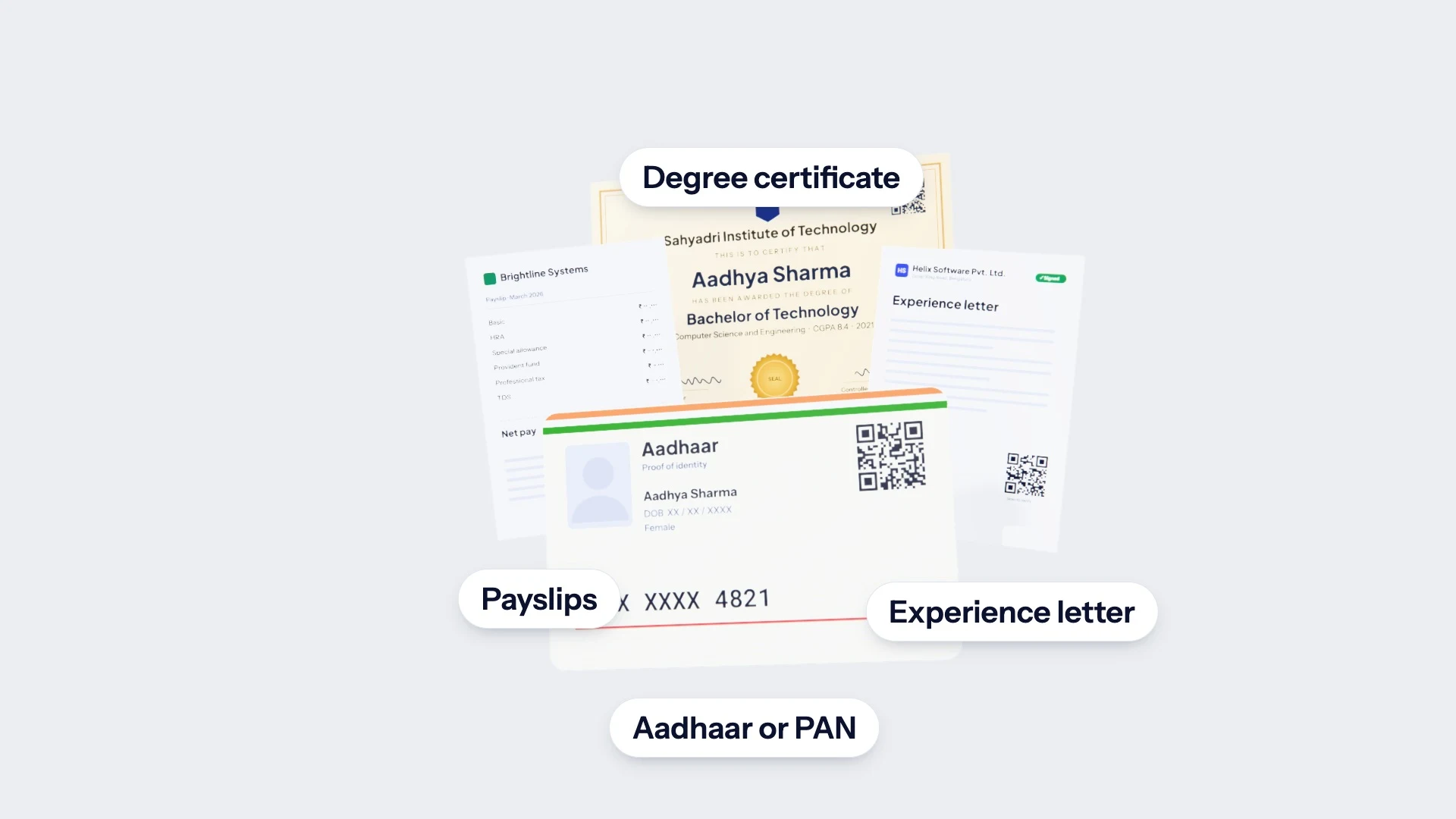
Most of the work above exists because a paper certificate cannot answer for itself. A certificate issued on Dygital.degree can. The university or college issues it in the NAD standard format, signed by the Registrar, Controller of Examinations and Vice-Chancellor, and anchored on Hyperledger. Scanning its QR code checks the certificate against the record the institution issued, so you see at once whether the copy in front of you matches. Any change to an issued certificate, even one digit of a CGPA, makes the check fail.
Students are notified when their certificates are issued and fetch them into ADi Wallet. When a candidate shares a degree from ADi Wallet, it reaches you as the issuer's record, with the candidate's approval, not as a scan someone has to chase. More than 20 universities and colleges issue on Dygital.degree, and over 200,000 certificates have been issued and over 100,000 verified on our network (Company data, Oct 2026).
For certificates still issued on paper, Checkkbox runs the check with the issuing university or college for you, alongside identity, employment and court record checks, with the results in one report. More than 150 verification agencies verify academic records on Checkkbox (Company data, Oct 2026). Identity, education and EPFO/TDS employment checks close in under 15 minutes when the candidate's records are on the network. Past-employer confirmation takes as long as their HR takes to reply.
If you run a registrar's office, issuing on Dygital.degree means employers stop writing to you about certificates you have already issued, because the QR check answers them. To see a degree confirmed against the issuer's record, from consent to report, book a demo.
Sources
- University Grants Commission, "State-wise list of Fake Universities as on February, 2026", accessed October 2026
- University Grants Commission, "The University Grants Commission Act, 1956", accessed October 2026
- University Grants Commission, lists of central, state, deemed and state private universities, accessed October 2026
- University Grants Commission, Distance Education Bureau, "Precautions to be taken by the students before enrolling in Programmes offered under ODL and/or Online mode", public notice F. No. 1-11/2025 (DEB-NER), September 2025
- University Grants Commission, Distance Education Bureau, "Precautions to be taken by the students before enrolling for Programmes offered under ODL and/or Online Learning mode", public notice, August 2020
- Supreme Court of India, Orissa Lift Irrigation Corp. Ltd. v. Rabi Sankar Patro and others, judgment dated 3 November 2017
- Ministry of Law and Justice (via MeitY), "The Digital Personal Data Protection Act, 2023 (No. 22 of 2023)", Gazette of India, August 2023